

In May 2025, Goldman Sachs paid a $1.45 million civil fine for inaccurately reporting billions of stock trades, driven by coding errors and supervisory lapses. If Goldman Sachs—one of Wall Street’s most sophisticated institutions—can stumble, what does that mean for the rest of us?
For many businesses, growth feels harder, slower, and riskier than it should. Reports don’t agree. Forecasts feel unreliable. Decisions take longer because leadership doesn’t trust the numbers. The problem isn’t a lack of data. It’s a lack of data integrity for business growth.
Data integrity means your information is accurate, consistent, and reliable across every system that touches it. When it’s strong, you make confident decisions. When it breaks down, everything suffers.
At Kinetic Technology Group, we’ve spent more than two decades helping businesses build technology foundations that actually support growth. This article explains why, in 2026, data integrity matters more than ever.
Executive Snapshot: What This Means for Your Business
Data integrity isn’t just an IT concern. It’s a strategic imperative that determines whether your growth plans for this year succeed or stall. Key takeaways:
- The hidden cost of bad data: Messy data quietly drains resources, delays decisions, and undermines leadership confidence in critical reports
- Compliance and security exposure: Poor data integrity increases audit risk and creates vulnerabilities that threaten operations
- Growth amplification: Scaling without clean data magnifies existing problems rather than solving them
- Action before planning: Addressing integrity now protects 2026 initiatives from being built on unreliable assumptions
What Is Data Integrity and Why Does It Matter for Business Growth?
If you’re a CEO, business owner, or executive responsible for strategic decisions, you need to pay close attention. You’re leading a company that depends on data to forecast revenue, manage operations, and plan for the future. The problem? Your systems don’t always tell the same story.

Data integrity for business growth means ensuring your information is accurate, consistent, and reliable across every platform your business uses. It’s about whether that data can be trusted when critical decisions are on the line.
If your CRM shows 500 active customers while your billing system counts 470, which number drives your capacity planning? Without a clear data integrity strategy, you’re making decisions based on assumptions rather than facts.
The Hidden Costs of Messy Data Most Companies Underestimate
The invisible costs of poor data integrity extend far beyond IT budgets. According to a study cited by HFS Research, 75% of business executives do not trust their data. When leadership can’t trust the numbers, decision-making slows and confidence erodes.
Executive data dashboards display conflicting information. Finance sees one revenue forecast while sales presents another. Operations believes inventory is sufficient while the warehouse reports shortages. These aren’t minor discrepancies. They’re strategic liabilities that prevent decisive action when timing matters most.
And the costs compound in ways that rarely appear on balance sheets. Teams spend hours reconciling reports instead of executing strategy. Compliance audits reveal inconsistencies that trigger penalties. Customer experiences suffer when billing, support, and sales work from different versions of the same account. Security exposures multiply as outdated or duplicate records create vulnerabilities.
Most damaging is the lost opportunity cost. When you can’t trust your data, you can’t move quickly on market opportunities, optimize operations confidently, or scale without magnifying existing problems.
Why Data Integrity for Business Growth Becomes Non-Negotiable in 2026
Messy data has always been costly, but in 2026, the stakes are higher than ever. As businesses increasingly rely on analytics, automation, and forecasting to drive decisions, the quality of your data directly determines the reliability of those insights. Poor data integrity doesn’t just slow you down—it creates compounding risks that grow alongside your business.

Regulatory expectations continue to tighten across industries, making compliance audits more rigorous and penalties for data mishandling more severe. At the same time, faster scaling demands cleaner alignment between systems. Growth amplifies weaknesses rather than hiding them, which means the gaps in your data infrastructure become more visible and more expensive to ignore.
To recap: future-proof data systems require intentional design, not reactive fixes. If your growth strategy depends on confident decision-making, secure operations, and scalable data infrastructure, addressing data integrity now isn’t optional. It’s foundational.
Case Study: How a Growing Company Paid the Price for Poor Data Integrity
This is a composite example based on common patterns we observe across industries.
According to Gartner research, poor data quality costs organizations an average of $12.9 million per year. For one mid-sized professional services firm with aggressive expansion goals, that statistic became painfully real. Planning to double its client base within eighteen months, the company seemed positioned for success—until messy data exposed the cracks in its foundation.
Before: The Breaking Point
Forecasting reports started contradicting each other. Legacy system data issues meant customer information lived in three different places with no authoritative source. CRM and ERP synchronization failed regularly, creating duplicate records and conflicting account details. Sales believed they had 450 active clients while finance counted 380. Without a single customer view (SCV), the executive team couldn’t determine which forecast was accurate or which clients were actually profitable.
The consequences compounded quickly. Compliance audits revealed data inconsistencies that triggered penalties. Revenue projections missed by 20 percent. Leadership lost confidence in reports, delaying strategic decisions that required reliable insights.
After: The Turnaround
Once the firm addressed data integrity systematically, establishing clear ownership and standardizing definitions across systems, forecasting accuracy improved dramatically. Reports aligned. Decision-making accelerated. The company finally had the data foundation needed to support its growth strategy with confidence rather than guesswork.
5 Practical Steps Leaders Can Take to Improve Data Integrity
If you’re reading this and thinking, “What should I actually do about it before 2026 planning locks in bad assumptions?” you’re asking the right question. Data integrity improvements don’t require a complete system overhaul or a multi-year transformation program. They require intentional, strategic decisions that leaders can make now.
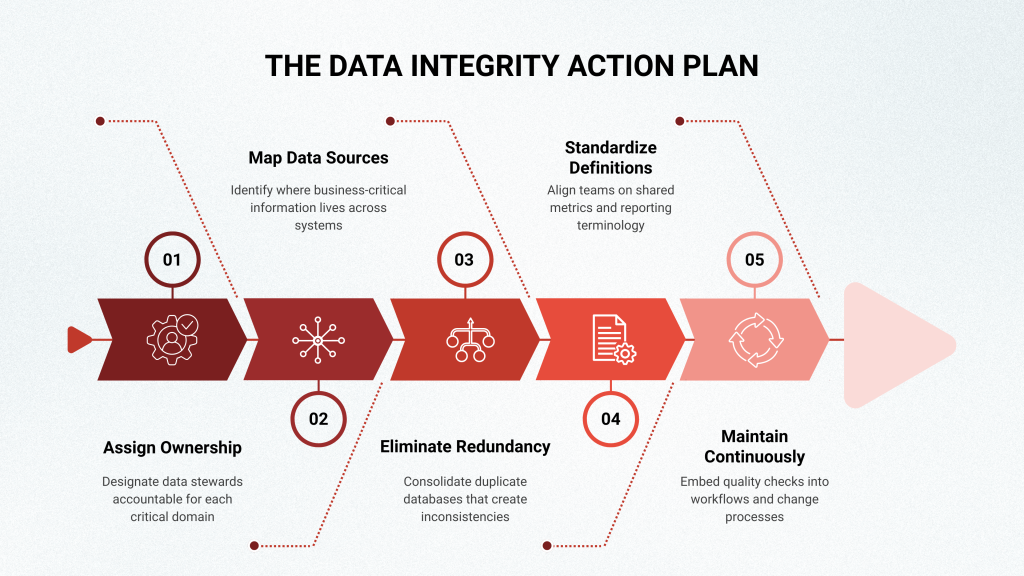
1. Establish Clear Data Ownership and Accountability
Someone needs to own the accuracy of customer data, financial records, and operational metrics. Assign data stewards within each department who are accountable for maintaining integrity in their domain.
2. Audit Where Critical Business Data Lives
Map your most important data sources. Where does customer information reside? How many systems touch revenue data? Use a data maturity model to benchmark where you are and identify realistic next steps.
3. Reduce Unnecessary Duplication Across Systems
Every redundant database increases the risk of inconsistency. Consolidation doesn’t mean replacing every system overnight—it means strategically reducing overlap where it causes the most friction.
4. Align Reporting Definitions Across Teams
IT and business alignment starts with shared language. When sales defines “active client” differently than finance does, forecasts will never match. Establish organization-wide definitions for key metrics and enforce them consistently across departments.
5. Treat Data Integrity as an Ongoing Discipline
Build data quality checks into your workflows and change management processes. As systems evolve and teams grow, maintaining integrity requires continuous attention, not periodic fixes.
Who Owns Data Integrity: IT, Leadership, or Both?
Data integrity isn’t solely an IT problem or a leadership responsibility. It requires partnership. As Data Governance: The Definitive Guide explains, data governance is where people, processes, and technology come together to make data trustworthy and usable at scale.
Leadership sets priorities and establishes accountability. IT enables the infrastructure, implements role-based access controls (RBAC), and maintains internal controls and oversight. When both sides align on ownership, data quality improves consistently.

Consider a finance team needing accurate customer data for billing. Leadership defines what “accurate” means and who owns updates. IT ensures systems enforce those standards. A trusted IT partner bridges this gap, translating business requirements into technical safeguards. The strongest data integrity programs recognize that success depends on collaboration, not delegation.
Frequently Asked Questions About Data Integrity and Growth
Is data integrity only a problem for large companies?
No. Small and mid-sized businesses face the same risks, often with fewer resources to recover. If you’re making decisions based on reports, data integrity matters regardless of company size.
How do we know if our data is actually unreliable?
Look for warning signs: reports that contradict each other, delayed decisions because leadership doesn’t trust the numbers, or manual workarounds to reconcile information across systems.
Can we fix data integrity without replacing our systems?
Yes. Most improvements focus on how data is managed within existing systems. Establishing ownership, standardizing definitions, and implementing validation rules can improve integrity without new infrastructure.
What about compliance and audit requirements?
Standards like SOC 2 require audit-ready data systems that demonstrate reliability. Strong governance enables risk mitigation through data—ensuring records withstand regulatory scrutiny.
For more on how compliance laws intersect with data governance, see Kinetic’s Data Privacy and Compliance resources.
Putting Data Integrity Into Practice with Kinetic Technology Group
Data integrity isn’t overhead. It’s a growth enabler. It protects your investments, strengthens your decisions, and positions 2026 initiatives on solid ground rather than shaky assumptions.
Since 2000, Kinetic has been making technology manageable for businesses navigating challenges like data compliance and governance, cloud data governance, SOC 2 compliance requirements, and ISO/IEC 27001 information security. Our IT consulting services help leaders translate data integrity from concept into practice.
If you’re ready to assess where your data stands and what steps make sense for your business, let’s have a conversation. Schedule a complimentary data integrity or IT assessment with our team. No sales pitch, just a straightforward discussion about your systems, risks, and priorities.


